The idea
A football match is one of the densest data objects in sport: thousands of passes, hundreds of shots, ninety minutes of shifting pressure. Most visualisations flatten all of that into charts a specialist has to decode. Data Portraits does the opposite — it turns the whole array back into something everyone already understands: two teams, a pitch, and the feeling of a game swinging one way and then the other.
The screen holds a single scene that plays through the match in real time. Nothing on it is decorative. Every ridge, tide and flash is driven by an actual event or measurement from the game.
How to read it
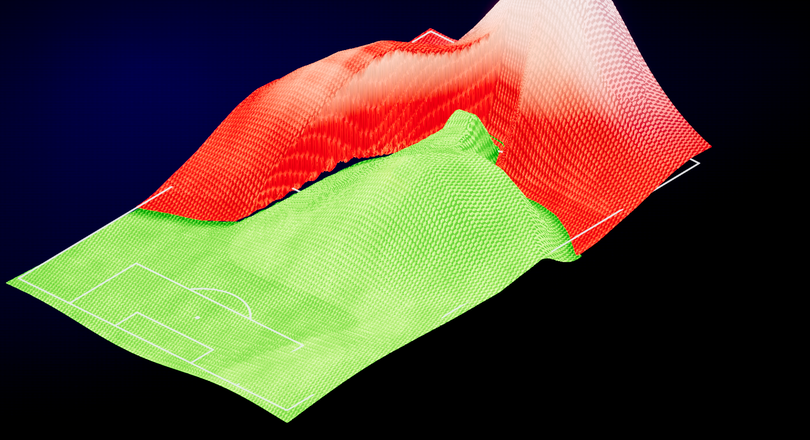
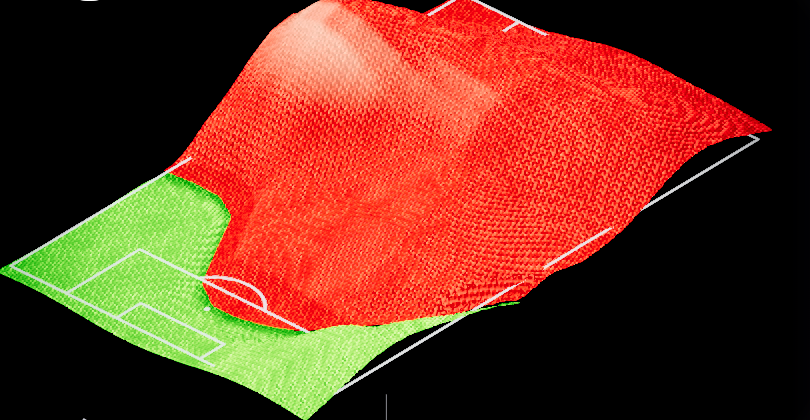
Two cloth blankets — one in each team's colour — lie over the pitch and meet along a moving seam. Watch that seam and the ground beneath it, and you can read the match without a single label.
- The two blankets One per team, in national colour. Together they cover the pitch; the fabric belongs to whoever controls that ground.
- The front The seam where the blankets meet is the possession / territory tide. As one side presses, its colour advances across the halfway line and camps in the opponent's half; when the game turns, the front rolls back.
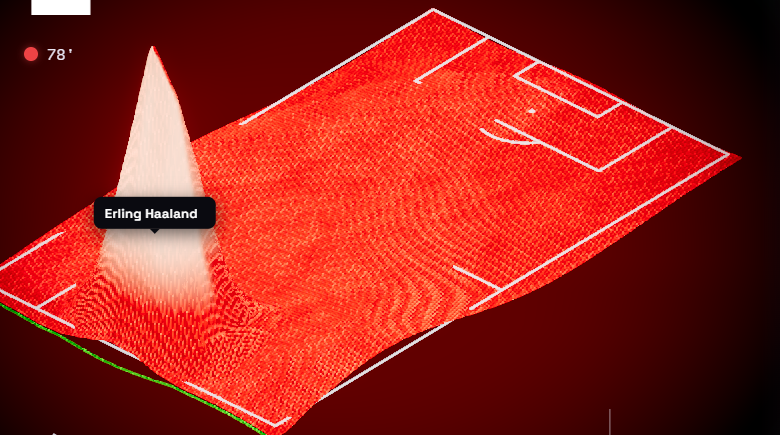
- The relief Hills rise out of the cloth wherever shots happen. Their height is xG — the quality of the chance — so real danger literally lifts the landscape.
- The goal flood A goal floods the whole pitch in the scorer's colour, a full-field wash that marks the moment the scoreline changed.
- The sky-lean Above the pitch, the sky leans toward the team in front — a quiet, ambient read on who is currently winning.
- The pulse Along the bottom runs a momentum seismograph: a single trace that spikes toward whichever team is on top, minute by minute — the heartbeat of the match.
- The shootout When a knockout tie goes to penalties, the piece closes with a shootout choreography — each kick scored or missed, in order, deciding who goes through.
What you're looking at
Three moments from one real Round-of-16 tie — Brazil 1–2 Norway — read straight off the cloth, with nothing but the picture to go on.
Methodology
The meaning is the data; the art is only in the execution. Everything you see is reconstructed from two independent, professional-grade sources.
Per-minute momentum from FotMob (the normalised valueNorm signal) drives the possession tide, the sky-lean and the pulse.
Shots, goals, cards and expected-goals values come from Opta data via WhoScored — these shape the relief and time every goal flood.
The mapping from those numbers to cloth, terrain and light is the author's own — a purpose-built generative system, not a template.
No mock data, no procedural noise for decoration. If a hill is there, a shot was taken; if the front moved, the momentum moved with it.
Player photos come from Wikimedia Commons, resolved via Wikidata (property P18); individual image licenses and authors apply per photo.
Limitations
This is an impression of a match, not a literal replay — a readable model built from the numbers, and it is worth being clear about where the model bends.
The possession front and the relief are low-pass smoothed: a filter rounds off the second-by-second jitter so the cloth breathes instead of flickering. What you read is a smoothed interpretation of the flow, not raw per-second truth. Player positions and territory are likewise an approximation reconstructed from the event stream — the shape of play, not exact tracking.
Time is not linear. The clock runs on dramatic time: it lingers on goals and big chances and races through routine passing, so a quiet ten minutes may flash past while a single shot is given room to breathe. The order of events is faithful; their on-screen pacing is deliberately warped for the story.
The goal
This is functional art: a piece whose beauty comes from being true. Football is one of the few data-rich subjects that a global audience already reads fluently — the perfect bridge between a serious analytical dataset and a broad, non-specialist viewer.
The ambition is simple and hard: take a huge, honest match array and make its structure instantly legible and genuinely beautiful — so that a lifelong analyst and someone watching their first World Cup can both look at the same image and understand the same game.